

Business continuity doesn’t fail on paper. It fails when the network does.
That’s not just a hunch. In the BCI’s Horizon Scan Report 2024, IT & telecom outages were ranked the #1 most disruptive standalone incident over the last 12 months (23.6%).
And when the report looks at frequency and impact together, IT/telecom outages still show up in the top 3 most frequent & impactful events ranked behind fraud/attempted fraud and cyber attacks.
Business continuity is not about uptime, it’s about survivability
Enterprises are increasingly good at planning what must continue during disruption, but far less prepared for how connectivity will perform when conditions degrade. When outages, congestion, infrastructure damage, or rapid relocations hit, fallback plans often come down to a single alternate carrier, manual switching, or ad-hoc fixes- that’s not resilience. That’s hope.
Where enterprise connectivity plans break down
Enterprises don’t struggle because they lack technology- they struggle because they fragment connectivity. Teams piece together mobile contracts, fixed lines, standalone satellite options, and vendor-specific failover tools. Each component can work on its own, but together they become difficult to operate under pressure. That’s why critical environments plan with a PACE mindset (Primary, Alternate, Contingency, Emergency): they expect failure and design connectivity to survive it.
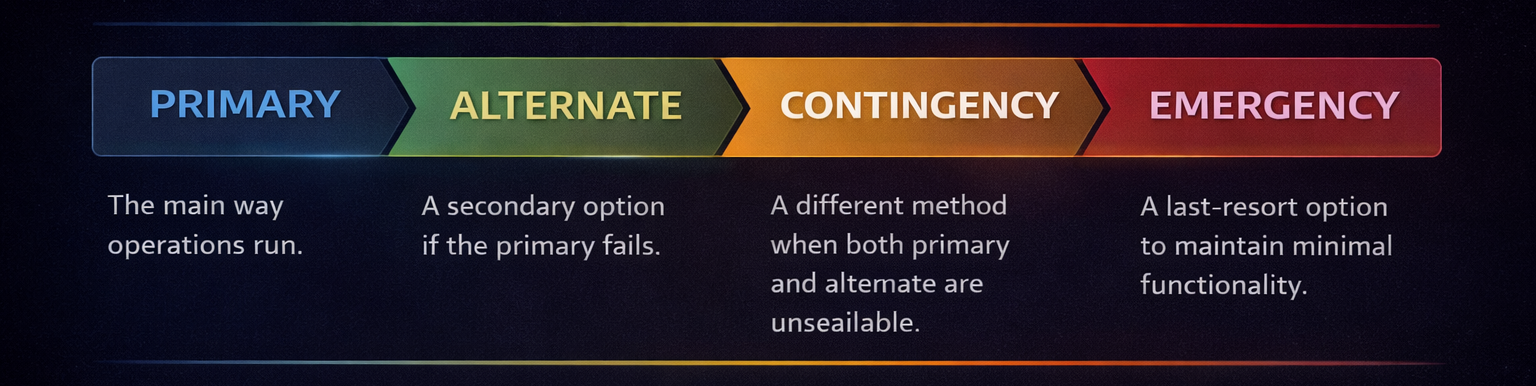
RebelGrid: operationalizing PACE for enterprise connectivity
RebelGrid was built to solve this problem not by adding another network, but by acting as a fully managed enterprise connectivity solution designed explicitly for failure scenarios. It provides an integrated, failure-aware connectivity layer that supports business continuity through multi-layered network resilience.
Applied through a PACE mindset, RebelGrid can support different roles depending on operational context:
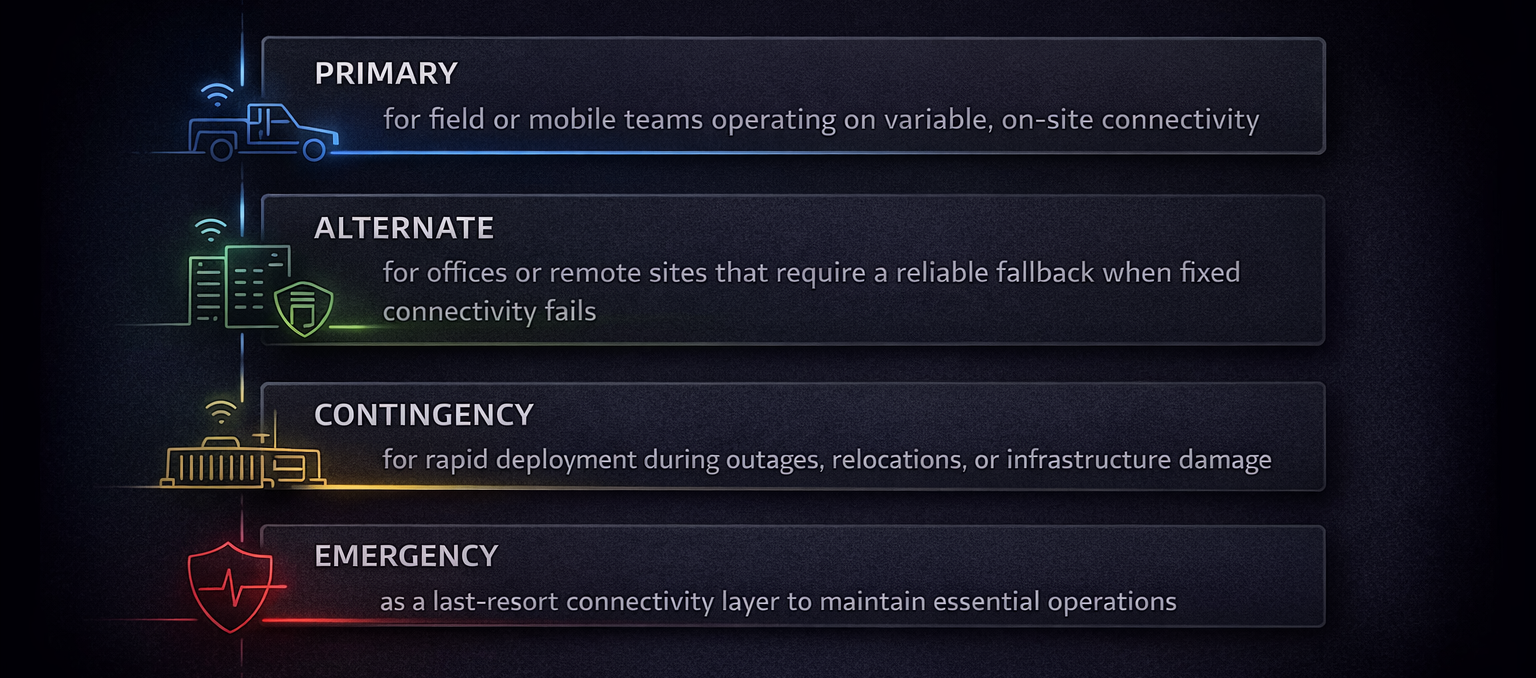
The key shift is this: rather than planning which link to switch to, RebelGrid helps organizations answer a more fundamental question- How do we stay connected, no matter what fails first?
Designing for failure changes business continuity outcomes
When connectivity is designed for failure:
– business continuity plans become executable, not theoretical
– temporary operations can be deployed faster, with less operational chaos
– risk shifts from “will it work?” to “how degraded can we operate?”
This is not about chasing perfect uptime. It’s about ensuring that when systems fail (as they inevitably will) the business does not.
A better baseline for resilient business continuity
Connectivity can no longer be treated as a static utility in modern business continuity planning. It must be layered, failure-aware, rapidly deployable, and simple to operate under stress and RebelGrid exists to make that possible.
FAQs:
Why does connectivity so often become the weakest link during major disruptions?
Because most enterprise connectivity is designed for availability in normal conditions, not for failure. Even setups with “multiple providers” often rely on shared physical infrastructure, shared aggregation points, or shared tunnels upstream. As a result, a single incident (congestion, regional outage, or upstream failure) can take out multiple connections at once. When that happens, manual failover and ad-hoc backups rarely work as expected.
Isn’t using two operators enough to ensure redundancy?
Not necessarily. Different operators can still route traffic through the same underlying backhaul, core network, or interconnection point. From the outside it looks redundant, but from a continuity perspective it may still be a single source of failure. Organizations build true connectivity resilience when they understand where traffic actually flows and design paths that fail independently under stress.
Does Rebelroam support PACE-based connectivity only through RebelGrid?
Not at all. RebelGrid is one way we operationalize a PACE mindset, but our approach is never one-size-fits-all. We work with organizations to design tailored connectivity strategies that can support Primary, Alternate, Contingency, and Emergency operations based on real infrastructure dependencies, risk profiles, and operational needs.
RebelGrid keeps operations connected, regardless of whether it plays a central or supporting role. If you want to explore what that looks like for your environment, just contact us.